
Think of a normal workweek.
On Monday it’s inbox triage and back-to-back calls. Tuesday calls for team alignment. Wednesday brings client sessions. Thursday, a workshop or a community event. The nature of work keeps changing. So why would the way we support it stay the same?
Hybrid work asks for choice.
Not because people want less structure, but because work itself is varied. Focused tasks, team alignment and shared moments all ask for different conditions to do their best work. No single setup supports every type of work equally well. Work naturally moves between concentration, collaboration and collective exchange.
That insight isn’t just intuitive. It’s something we increasingly see confirmed in how people work, and what helps them work well.
When people talk about hybrid work, the conversation often revolves around where work happens – home versus office. But the more interesting question is how work is supported.
What makes the difference isn’t location alone, but choice. Choice in how people use spaces. Choice in how environments support different tasks throughout the day.
Across many workplace studies and real-world observations, a consistent pattern emerges: when people can choose the setting that fits their work, they tend to be more engaged, more focused and more at ease.
Some tasks ask for deep focus. Others work best through discussion, alignment or shared energy. Problems arise when all of this is forced into one fixed environment.
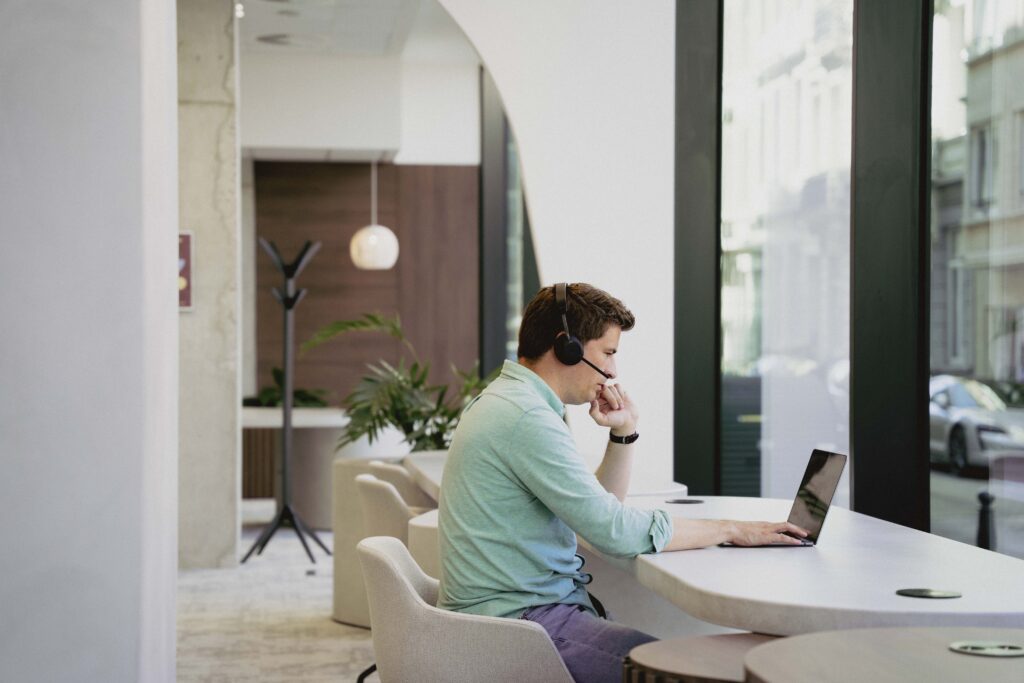
Workplaces that offer a mix of settings – quiet areas, collaborative zones, informal spaces – give people the freedom to shift as their work shifts. That flexibility reduces friction. It makes transitions between tasks smoother. And it helps people stay productive without constantly adapting themselves to the space.
Flexibility also changes how work feels. Having control over your environment – light, noise, privacy, proximity to others – reduces cognitive strain and helps people stay balanced throughout the day.
The pattern is clear: Less friction, fewer interruptions and the ability to choose the right setting all contribute to lower stress and more sustainable work rhythms.
Put together, these insights point to one clear conclusion. Hybrid work isn’t just about splitting time between places. It’s about creating conditions that support different types of work as they naturally occur.
That’s why flexible workspace models matter. Not because they are “new offices,” but because they:
In short, hybrid work works best when environments adapt to work, not the other way around.
When flexibility becomes the guiding principle, workspaces stop being fixed destinations and start functioning more like infrastructure: something you tap into when needed and step away from when you don’t.
MeetDistrict puts this thinking into practice through a simple, consistent setup across its hubs. Instead of committing people to a single office or predefined use, it allows them to choose environments that fit the moment. SilentSpaces for focused work. SharedSpaces for collaboration. Rooms that scale naturally from meetings to workshops or talks.
The experience is intentionally straightforward. Spaces are bookable when needed, supported by reliable connectivity and on-site presence, without long-term constraints. In that sense, the workspace becomes plug-and-play – available when work calls for it, invisible when it doesn’t.
Across Ghent, Antwerp, Brussels and Diegem, the same logic applies. One ecosystem, multiple cities, and the freedom to use only what supports the work at hand.
In a work landscape where tasks, teams and rhythms constantly shift, this kind of flexibility isn’t an add-on. It’s a practical response to how work actually happens today: varied, dynamic and rarely predictable.
We care about the protection of your data. Read our Privacy Policy.
Our workplaces comply with three prestigious ISO standards.


MeetDistrict Berchem, Brussels and Diegem are located in BREEAM-certified buildings.
